Case study
ResearchMind — Personal Research Intelligence System
Role / statusIndependent project
Date2026 · 3 months
Strongest verified outcomeProduction ML pipeline delivered
01 — Context
Problem
ML literature assistant that surfaces unsolved research directions from an indexed paper corpus.
02 — Approach
Solution
The workflow below is a visual summary of the documented implementation; it is not a claim of additional system components.
- 01
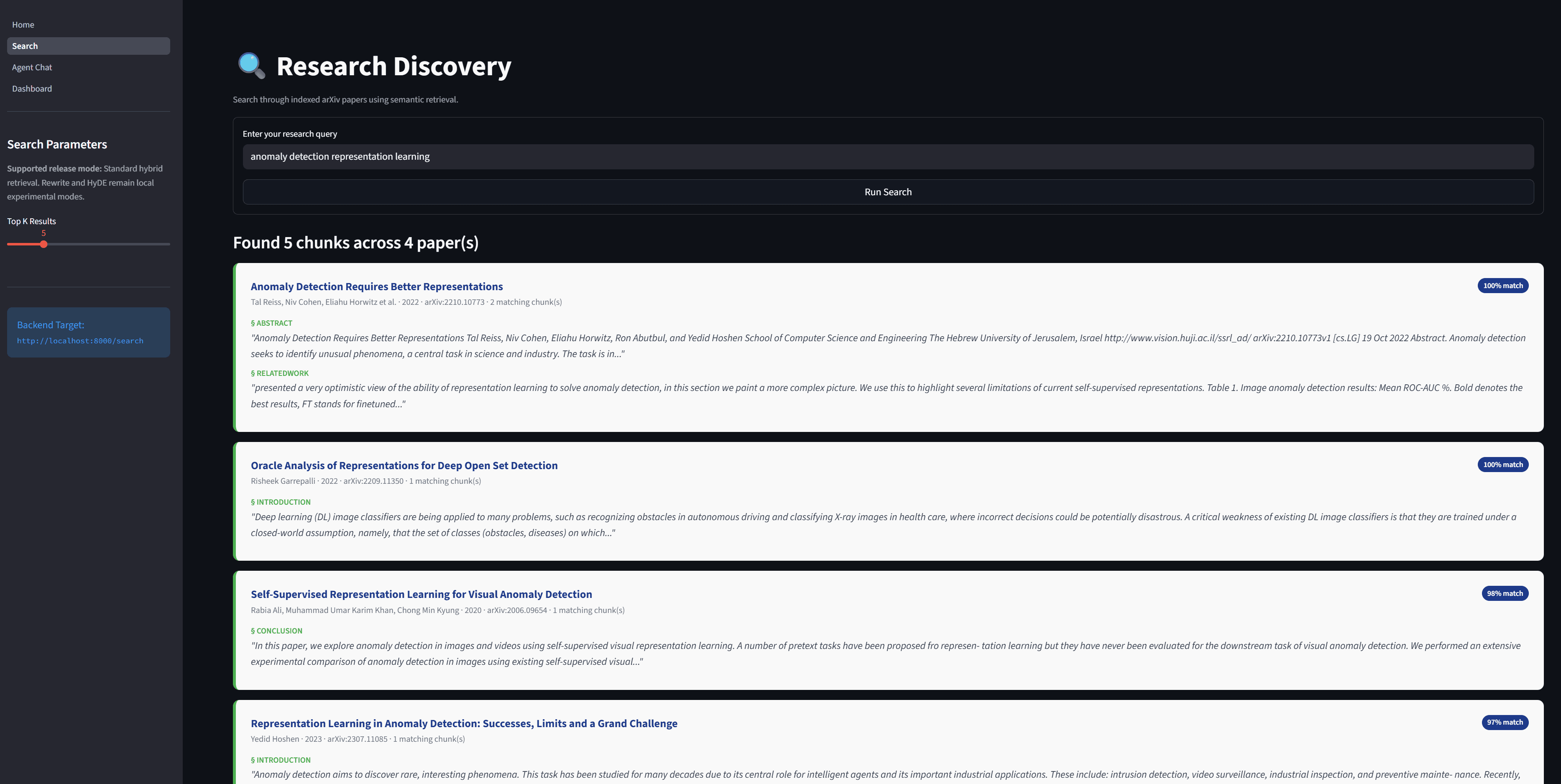
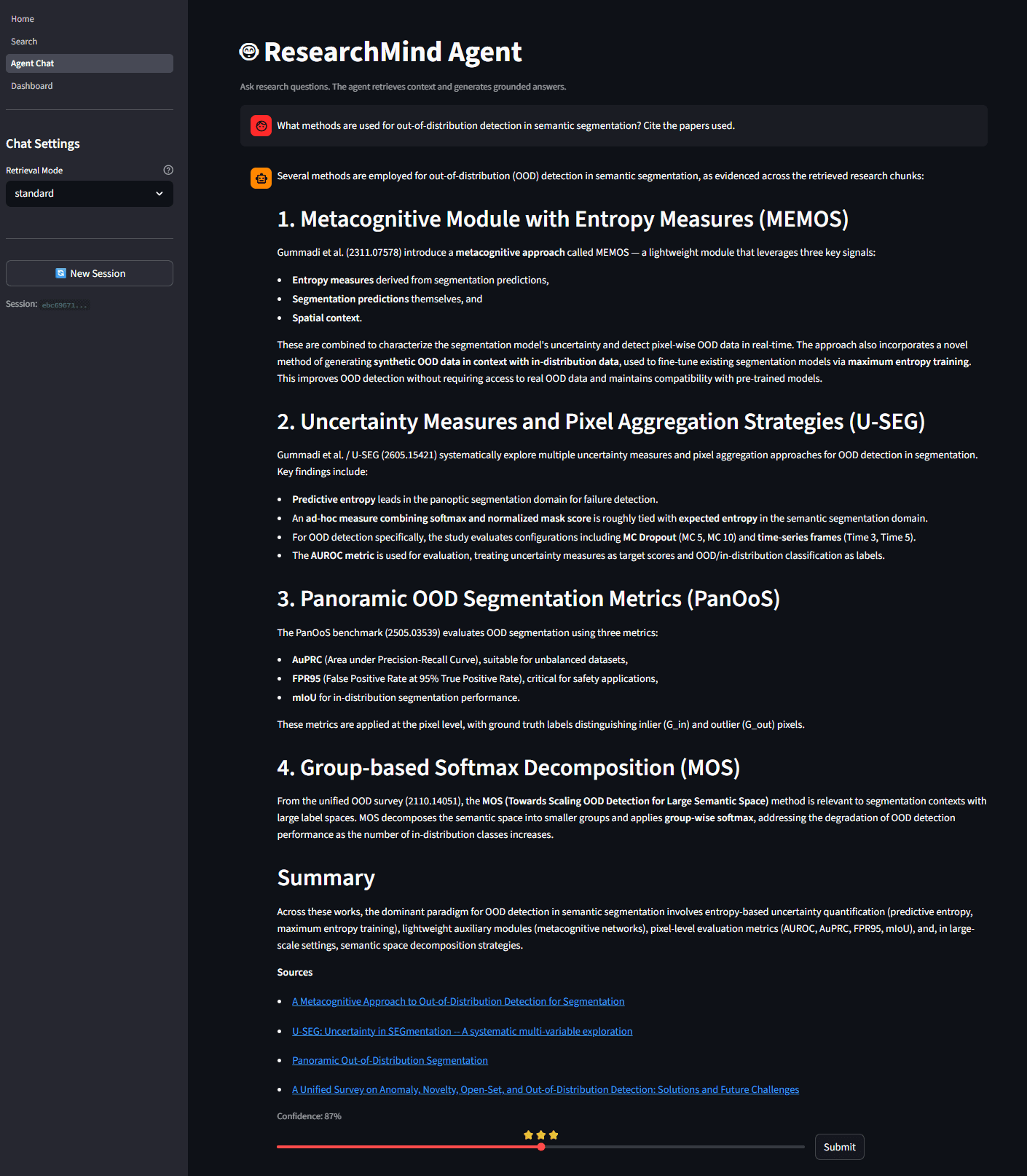
Engineered a hybrid retrieval pipeline over 1,317 ML papers combining BM25 and dense retrieval with RRF fusion; benchmarked embedding models and FAISS index types, achieving Recall@10 of 0.97 with MPNet and 91% p95 latency reduction with HNSW32
- 02
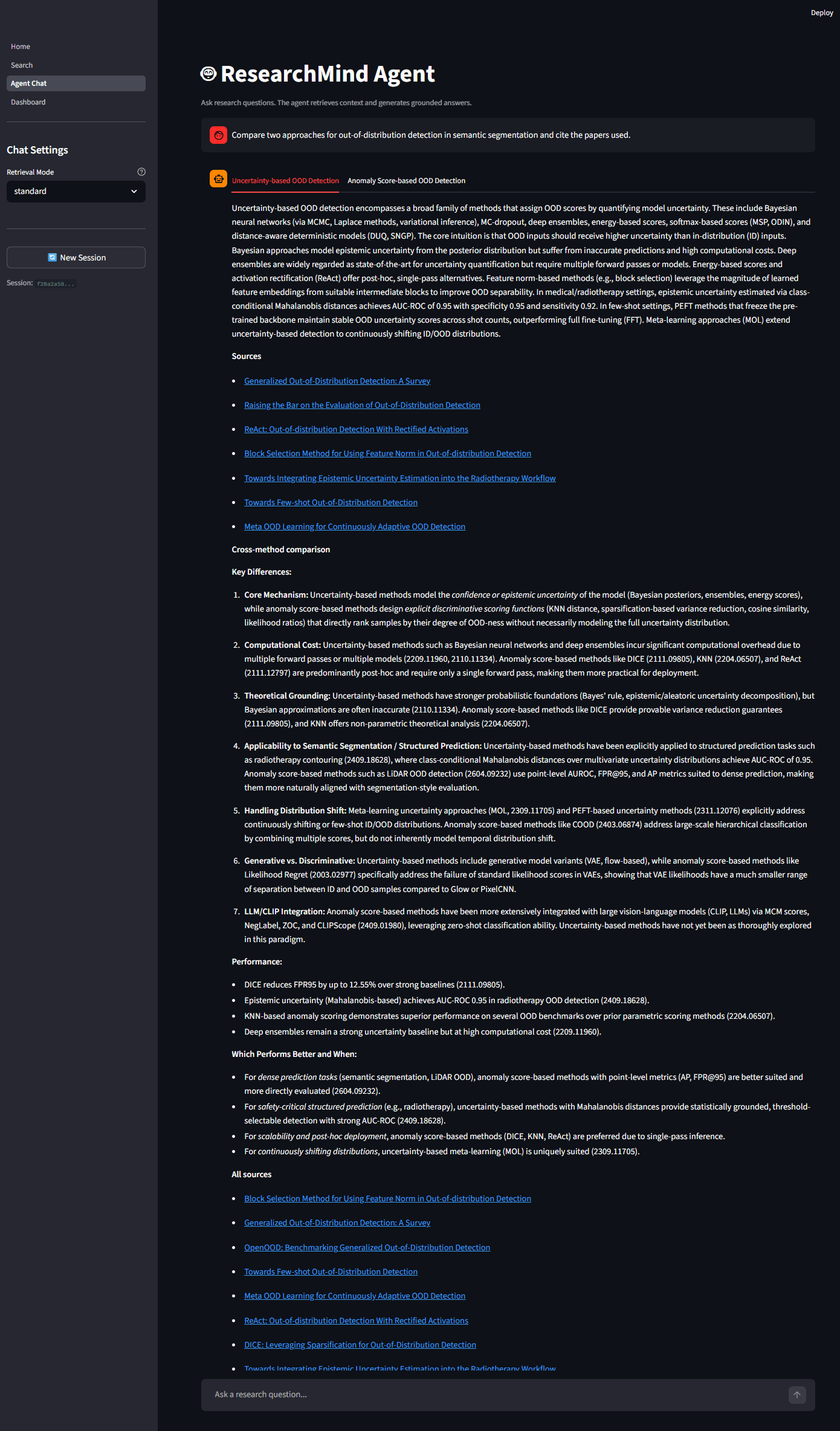
Built a 7-tool LangGraph agent with intent-based routing using a configurable LLM backend supporting both local and API-hosted models at temperature 0, achieving 100% classification accuracy on 110 labeled queries, supporting gap detection, methodology comparison, citation graph traversal, and multi-turn memory
- 03
Implemented a 4-stage RAG validation pipeline covering citation grounding, hallucination scoring, and gap schema validation with a rejection threshold of 0.70, averaging a hallucination score of 0.80 on eval; clustered low-rated queries using k-means to surface systematic retrieval failures
03 — Engineering judgment
Key decisions
Built a 7-tool LangGraph agent with intent-based routing using a configurable LLM backend supporting both local and API-hosted models at temperature 0, achieving 100% classification accuracy on 110 labeled queries, supporting gap detection, methodology comparison, citation graph traversal, and multi-turn memory
Implemented a 4-stage RAG validation pipeline covering citation grounding, hallucination scoring, and gap schema validation with a rejection threshold of 0.70, averaging a hallucination score of 0.80 on eval; clustered low-rated queries using k-means to surface systematic retrieval failures
Deployed on HuggingFace Spaces with a FastAPI backend, Redis caching achieving 93% latency reduction, and sustained 15 RPS at 80 concurrent users under Locust load testing with a RAGAS faithfulness baseline of 0.775
04 — Evidence
Results
This project record verifies the delivered implementation, but does not report a comparable performance metric.
Product & System Views
Continue exploring
See another case study or learn more about my background.